
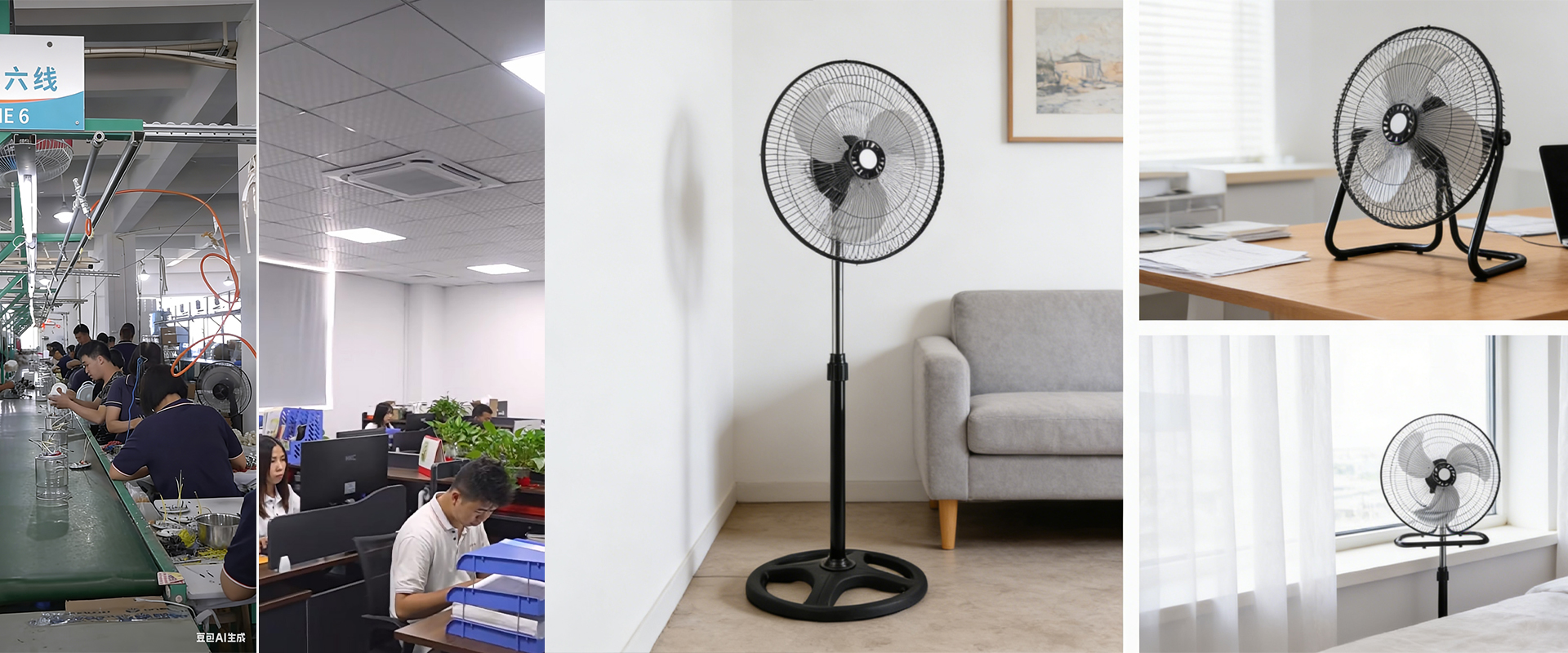
OEM and ODM are described so often as a binary choice that buyers rarely notice the more useful question: on which parts of the product do you need to own the decision, and on which parts is it cheaper to accept someone else’s? For small household appliances, the honest answer is usually a mix, and the mix changes as your volume and your brand mature.
This article sets out where each model actually starts, what it demands from the buyer, and how to decide for a first order without over-committing on either side.
Quick answer: ODM starts from a product the factory already makes and adapts it — fastest and cheapest, but you inherit the structure and often share it with other buyers. OEM starts from a specification or a sample you own and builds the product around it — slower and more expensive, but the structure, tooling and differentiation are yours. Most first orders are best served by ODM on the structure with OEM on the market-facing details: voltage, plug, marking, packaging and any one visible differentiator.
In this article
Where each model actually starts
The distinction is not about who designs the logo. It is about who defines the product.
| ODM | OEM | |
|---|---|---|
| Starting point | A product the factory already produces and sells to other buyers | A specification, drawing or physical sample supplied by the buyer |
| Who defines the structure | The factory | The buyer |
| Who owns the moulds and tooling | Normally the factory | Can be the buyer, if it is agreed and paid for |
| Typical first-order timeline | Short — the product exists | Long — tooling, samples, validation |
| Cost to the buyer at the start | Low | Tooling and development cost, sometimes significant |
| Differentiation available | Surface-level: colour, marking, packaging, voltage variants | Structural and functional, within what the tooling allows |
ODM for small appliances in practice
An ODM appliance is a platform: a kettle, a fan, a juicer or a rice cooker that already exists in the factory’s range, with existing tooling and existing certification on at least one market. What you can change without touching the platform:
- Colour and finish of the outer housing, where the part is not shared with a compliance critical assembly
- Brand marking, by print, laser or label
- Voltage, frequency and plug configuration, which are configuration changes rather than structural ones
- Packaging, manual and any bundled accessory
- Small cosmetic details: trim colour, handle finish, a moulded-in logo on a part that already has a logo recess
What you generally cannot change without turning it into an OEM project: the internal layout, the heating or motor specification, the capacity of the main vessel, and the safety-critical geometry.
OEM for small appliances in practice
An OEM appliance starts from your specification. In practice this means one of three inputs: a full technical drawing set, a physical sample the factory reverse-engineers, or a written performance specification the factory designs against. Of these, a physical sample plus a written performance requirement is the most common combination, because it is faster than a drawing set and more precise than prose alone.
The variable that decides the timeline and the cost is tooling. Every injection-moulded part that differs from an existing platform needs a tool. A first OEM appliance typically involves several new tools — housing, base, perhaps a handle and a lid — and tooling lead time sits ahead of the sample stage, not beside it.
Side-by-side comparison
The same six questions, answered for each model. The right side of this table is why OEM is expensive; the left side is why ODM is limiting.
| Question | ODM | OEM |
|---|---|---|
| How fast can we see a sample? | Days to a couple of weeks, because the product exists | Weeks to months, because tooling comes first |
| What is the minimum order? | Lower, since tooling is already amortised | Higher, because the tooling cost has to be recovered |
| Can we be the only buyer of this product? | Rarely; exclusivity must be negotiated and is time-limited | Yes, if you own the tooling and the agreement says so |
| Can we change how it works? | Only within the configuration options the factory already offers | Yes, within what the tooling and certification allow |
| Who carries compliance? | The factory, for the platform it already certified | Shared: the factory builds, the buyer must still confirm the product meets the market requirement |
| What happens when we want to change supplier? | You leave the product behind and start again | You can move the tooling, if you own it |
What each model demands from you as the buyer
| Buyer responsibility | ODM | OEM |
|---|---|---|
| Market and compliance requirement | Confirm the platform is certified for your market, and check the certificate scope | Define it up front; the whole design follows from it |
| Product specification | Select from what exists and document the chosen configuration | Write it: performance, dimensions, materials, safety |
| Branding and packaging | Own it fully — this is where your differentiation lives | Own it fully, plus the product-level design |
| Sample approval | Approve a configuration sample and a golden sample | Approve tooling samples, then pre-production samples, then golden sample |
| Liability for design faults | Largely the factory’s | Shared, and usually negotiated in the contract |
The most under-rated item is the first row. On an ODM platform the certificate exists, but its scope matters: a certificate covering one model variant does not automatically cover the variant you are buying with a different voltage and a different plug. Ask to see the certificate and check that your configuration is inside it.
The hybrid route, and why it is usually right for a first order
In practice most successful first appliance orders are neither pure ODM nor pure OEM. They take an existing platform and change the things that matter to the buyer’s market while leaving the structure alone.
A workable split for a first order:
| Element | ODM (accept the platform) | OEM (own the decision) |
|---|---|---|
| Internal structure and main tooling | Yes — the platform | No |
| Heating, motor or capacity specification | Yes | Only if the market demands it |
| Voltage, frequency, plug | Configuration change | — |
| Compliance labelling and manual | — | Yes |
| Product marking and colour | — | Yes |
| Packaging, carton, inserts | — | Yes |
| One visible differentiator | — | Yes, if achievable without a new tool |
That last row is where judgment is needed. A differentiator that needs no new tool — a colour, a trim part, a handle finish on an existing part — gives a genuine market difference at ODM cost. A differentiator that needs a new mould is an OEM project, and should be budgeted as one.
Tooling, IP and exclusivity
Three arrangements need to be in writing before production starts, whichever model you choose.
Tooling ownership
If you pay for a tool, the tool should be yours, stated in the purchase order, with a clause on where it is stored and what happens if the relationship ends. An OEM buyer who pays for tooling but does not own it has bought a product, not an asset.
Exclusivity
On an ODM platform, exclusivity is a commercial term, not a technical one. It is usually time-limited and territory-limited, and it usually costs something — either a higher unit price or a committed volume. Ask for the term, the territory, and what happens to the factory’s other buyers in the same market.
Design rights and industrial property
If your design is genuinely new, the design registration in your market matters more than the mould. Register before the product is shown at a trade fair, and make sure the factory agreement assigns design rights in the tooling output to you. This is the one area where a cheap conversation at the start saves an expensive one later.
A decision framework
Five questions, answered honestly, point to a model. Score each one for your own situation. Whichever way the score falls, the answers only mean something if the factory has been checked first — our pre-order audit checklist for a small appliance factory covers the documents, production lines and sample records worth asking for before a model decision becomes a purchase order.
| Question | Answer points to ODM | Answer points to OEM |
|---|---|---|
| Is there an existing product that already meets 80% of your requirement? | Yes | No |
| Do you have a specification or a sample you can hand over? | No | Yes |
| Is your first order volume enough to absorb tooling? | No | Yes |
| Does your brand need a visibly different product, not just a different label? | No | Yes |
| Do you need exclusivity in your market from day one? | No | Yes |
Three or more answers on one side is a clear indication. A split result means the hybrid route: accept the platform and own the market-facing layer.
Four mistakes that cost real money
- Ordering OEM tooling before the market is tested. Tooling is the largest irreversible spend in an appliance project. Test the product category with an ODM build first, then invest in differentiation once you know the product sells.
- Assuming an ODM certificate covers your configuration. Voltage and plug variants may sit outside the certificate scope. Check the certificate against the exact model you are buying.
- Treating packaging as an ODM item. On a shared platform, packaging and marking are most of what makes the product yours. Under-specifying them wastes the one layer you fully control.
- Paying for tooling without a written ownership clause. Without it, the tool remains with the factory and switching suppliers means starting again.
Frequently asked questions
Do you support both OEM and ODM cooperation?
Yes. Our main product lines — kettles including travel models, juicers, floor fans, mini travel fans and rice cookers — are available as ODM platforms with configuration and branding changes, and we also produce to customer samples or specifications as OEM work. Which one fits depends on how much of the product you need to own.
Can we mix different models in one order?
Yes, mixed models can be produced and shipped together, including mixed packing across the models in the order. Mixing does affect the packaging specification, because carton counts and dimensions differ per model, so it should be stated when the order is placed rather than added at packing.
What is the minimum order for an OEM appliance?
It is driven by the tooling. An ODM configuration has a low minimum because the tooling is already amortised. An OEM appliance needs the tooling cost recovered across the order, so the minimum is set by the tooling rather than by the production line. We quote the two separately so the arithmetic is visible.
How long does an ODM order take compared with OEM?
ODM is faster because there is no tooling stage: samples in days to a couple of weeks, then bulk production. OEM adds tooling lead time and at least one extra sample round before bulk, so the difference is measured in weeks rather than days.
Can we get a sample before committing to an order?
Yes. For an ODM platform we can send a sample of the closest existing configuration quickly. For OEM work the first sample follows tooling, so it takes longer and is usually charged, with the charge handled against the bulk order.
Not sure which model fits your first appliance order?
Send us the product category, your target market, the quantity you are considering and whether you already have a specification or sample. We will tell you honestly whether an existing platform covers your requirement, or whether tooling is unavoidable — and quote both routes so you can compare.
Related: private label and packaging engineering
Branding layers, marking methods, carton board grades, FBA and retail packing rules, and the cost items that scale with quantity.
Related: serving several markets from one order
Variant layers, mixed cartons and container planning — what changes when one order has to cover several destinations.
Related: matching voltage and plug to the destination market
Socket types, voltage bands, cord and plug certification, and how the same platform is re-specified for different destinations — the technical half of any private-label order that has to ship into more than one country.